
EMUS – Happy Days With Residents of Coastal Village
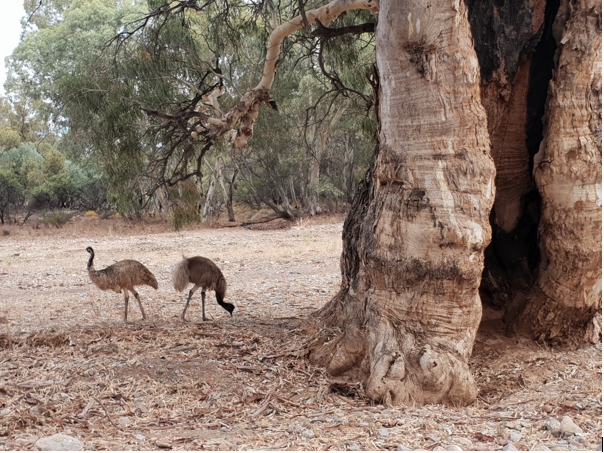
Photo: In the Flinders Ranges photo by Maria Taylor Share this page EMUS – HAPPY DAYS WITH RESIDENTS OF COASTAL VILLAGE Emus ranged widely across Australia and were numerous on the east coast when the European colonists started arriving in the 18th century. Like other Australian native grazing animals they continue to play a vital role in managing their habitats/ecosystems leading to the landscape we inherited (more on that later in this story). The large flightless birds were recorded as joining colonists on parade in Sydney in a friendly fashion in the early days before the hunting started. But soon a removal policy to suit European -style agriculture targeted emus as it did other Australian natives. A historical climax of this policy came with an infamous but also bemusing ‘emu war’ in WA that even drew in the Australian military. Emus and their eggs have continued to be the target of agricultural land managers, particularly in the west and Australian governments have supported the removal of indigenous species everywhere (until they become formally ‘endangered’ and then bureaucracies take a bow for doing something positive).A recent report in the Sydney media documented the prevalence of lethal removal of wildlife by urban developers amongst their first activities at a site. Mammals are poisoned and birds like cockatoos and hawks become the victims of secondary poisoning eating the carcasses. Many bird species and their nests are also the victims of chainsaw destruction. https://www.smh.com.au/environment/ conservation/the-sydney-suburbs-where-developers-are-killing-the-most-wildlife-20260209-p5o0m9.html Coexistence in a coastal village Against that background, a good news story from the NSW South Coast was great to see as we strive for coexistence with our remaining wildlife. The following heart-warming and unexpected neighbourhood story from Potato Point comes with thanks to an ABC report by James Tugwell with some of his reported quotes and supplied images repeated below. https://www.abc.net.au/news/2025-05-17/potato-point-emu-population-east-coast-beach/105185358 “A businessman shipped in a population of about a dozen emus from Western Australia 30 years ago to live on his private island — Horse Island — at the mouth of the Tuross River.”What he didn’t realise was that emus are proficient swimmers, and soon his imported pets had made a break for the mainland — 20 to 100 metres away, depending on the tide”. Photo: supplied: Eurobodalla Shire Council Tugwell quotes local wildlife volunteer Rachel McInnes who didn’t know Potato Point, 8 kilometres east of Bodalla, had emus when she moved to the area 18 years ago. “It’s a joy to go out your back or front door and see a couple of emus walking down the street,” she says.”It’s hilarious when you look down on the beach and think: ‘What’s that? Is that a person? No, it’s an emu.’. She said seeing the wildlife makes living in a beautiful place even more special. Photo: with local surf lifesaver, supplied: Eurobodalla Shire Council Ms McInnes said humans and emus live together in harmony at Potato Point. “They are protected here. We give them space and they are happy to coexist.” But for visitors and tourists, she warns off selfie shots. “Don’t ever think you’re going to get a selfie with a wild emu. They are absolutely a wild animal.”The population struggled at first. But Tugwell reports that with the National Parks and Wildlife Service placing fox baits throughout the national park, Potato Point and the surrounding Eurobodalla National Park have become an emu haven.”Every year we see chicks, and lots of them,” Ms McInnes said. t’s a topic of conversation when the new chicks are hatched: ‘How many have you seen? This year, one local spotted a male emu with 21 chicks.” Emu ecological role From public sources we learn that emus play a crucial role in maintaining the health and biodiversity of Australian ecosystems. Their grazing helps control vegetation growth as they disturb the soil, promoting seed germination and increasing plant diversity. Their droppings provide essential nutrients for plant growth. Emus are also seed dispersers, aiding in the regeneration of native vegetation. They have a unique digestive system that utilizes grit and stones to grind up their food, and they follow migratory locust swarms, feasting on the insects. Emus are omnivorous, eating seeds, flowers, fruits, and tender roots. In summer, they eat insects, especially caterpillars, beetles, and grasshoppers, and also small vertebrates.The ABC story includes an interview with Western Sydney University ecological statistician Julia Ryeland who said emus are catalysts for bush regeneration by transporting seeds that get stuck in their claws or that pass through their digestive system. She said they are quite a key seed disperser among different landscapes.”They are one of the few species that are completely generous. They more or less eat anything, and they can transport really large amounts of seed really quite far distances…”Author and journalist and AWPC editor Maria Taylor has documented the ongoing story of native animal removal in Australia in her book ‘Injustice… ‘
