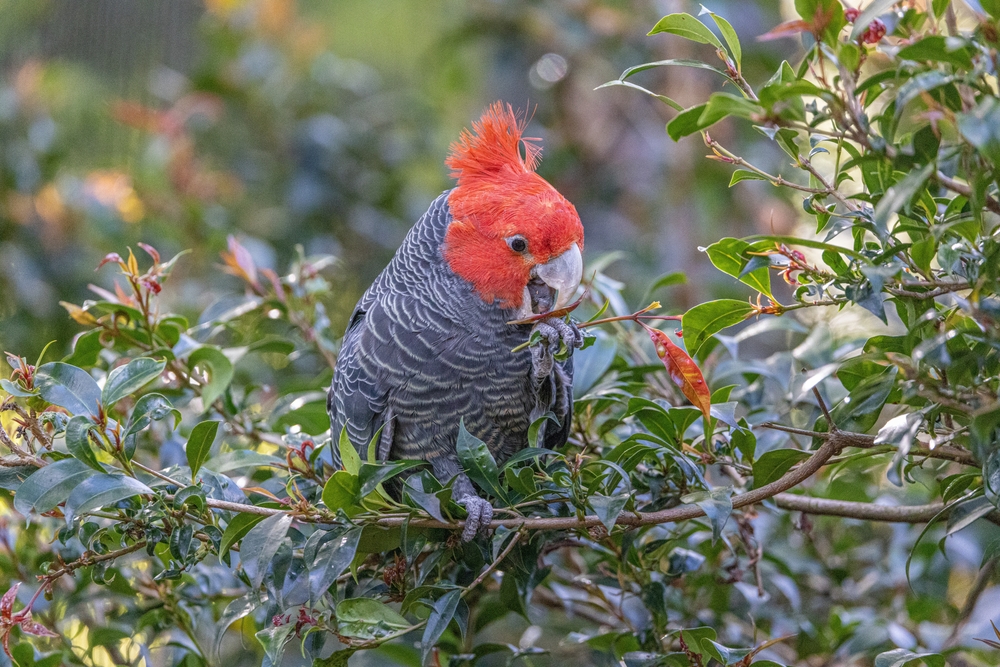
Gang Gang cockatoos

Share this page

NATIVE ANIMALS UNDER INTENSE FIRE: DO WE CARE?

The belated release of the 2021 federal State of the Environment report offered a grim picture of the state of Australia’s native biodiversity – decline, loss and poor ecosystem management are the major findings, along with the current lack of factoring in impacts of climate change on ecosystems and habitats.
The report found that the number of Australian threatened plant and animal species has increased by more than 200 between 2016 and 2021 to almost 2000 (1,918 in June 2021 up from 1,774 in 2016) with Gang-gang cockatoos and a northern hopping-mouse most recently joining this list of concern and shame.
More than a third of Australia’s eucalypt woodlands have been extensively cleared, and worse figures are reported for some other major vegetation groups
According to the state of environment report, “within 20 years, another seven Australian mammals and ten Australian birds – such as the King Island brown thornbill and the orange-bellied parrot – will be extinct unless management is greatly improved.” The report recommends that “Australia needs better and entirely new approaches to environmental management”.

Australia tops rate of mammalian extinctions

With colonial/settler impacts on the natural environment in the past 230 years, Australia has the dubious distinction of owning the world’s highest rate of mammalian extinctions. This is not accidental or just due to the predations of imported cats and foxes on small native animals as we are often told. It is very much the outcome of both colonial and post-colonial practices, traditions and beliefs in a new nation dedicated to exporting ‘resources’ that include sentient animals badged as commodities.
At stake now is not only the fate of endangered species but also that of so-called ‘common’ Australian species that are not yet on a threatened list. They are on the hidden front-line of a national tradition of persecuting, financially exploiting, and removing native wildlife that is inconvenient to business interests deemed vital to the economy, underpinned by the thinking of a colonial enterprise.

Beliefs and traditions guiding wildlife management

The beliefs and traditions of western colonialism can be called a religion in the sense of ‘beliefs to live by’. In parallel, the normative ethics and practices of wildlife ‘management’ stem from western European philosophical and agricultural traditions, not least a nation-building commitment to private property and extensive land-owner rights. Resident wildlife and the immediate natural environment are treated as owned property with no rights.
The British also embedded an empire-building biological science tradition dedicated to developing the colonies – with imports like wool sheep – as back paddocks to the motherland.  In Australia as a result, applied ecology and related wildlife management priorities have kept strong links to the interests and beliefs of sheep farmers and other agricultural and economic enterprises considered important to the new nation of Australia.
Christian beliefs came with the new nation. Contemporary wildlife management in Australia (and New Zealand), with a frequent pivot to lethal tools, may seem unremarkable to those who accept Christian teachings revolve around ‘dominion’ or domination by humans over nature and other species – in contrast to the emerging and attractive Christian view of humans playing a stewardship role to the natural world and its fauna and flora.
Stewardship is closer to the worldview of Australia’s First Nations. Indigenous knowledge views ‘Country’ – the Australian land and everything on it, sentient and not – as interconnected and with mutual responsibilities. For those schooled in the western tradition, it’s akin to the biological concept of the natural web-of-life that underpins societal existence.
In their new book ‘Songlines, first knowledges’ Margo Neale and Lynne Kelly write: [The] knowledge carried in the Songlines [also known as Dreaming tracks] decrees that humans are equal with all things animate and inanimate. Together we form part of a web, in which each component sustains the land…. Every single thing has a place and a kinship with humans.”
The dramatic loss of Australian biodiversity is linked to the background of beliefs and values that came with colonial settlement and a history of dispossession and disrespect for the unique continent and its fauna and flora (paralleling the dispossession of the indigenous people themselves) on behalf of a wholesale landscape makeover to European ideals and profit-making developments. Native animals became badged as pest or product, or recreational killing targets.
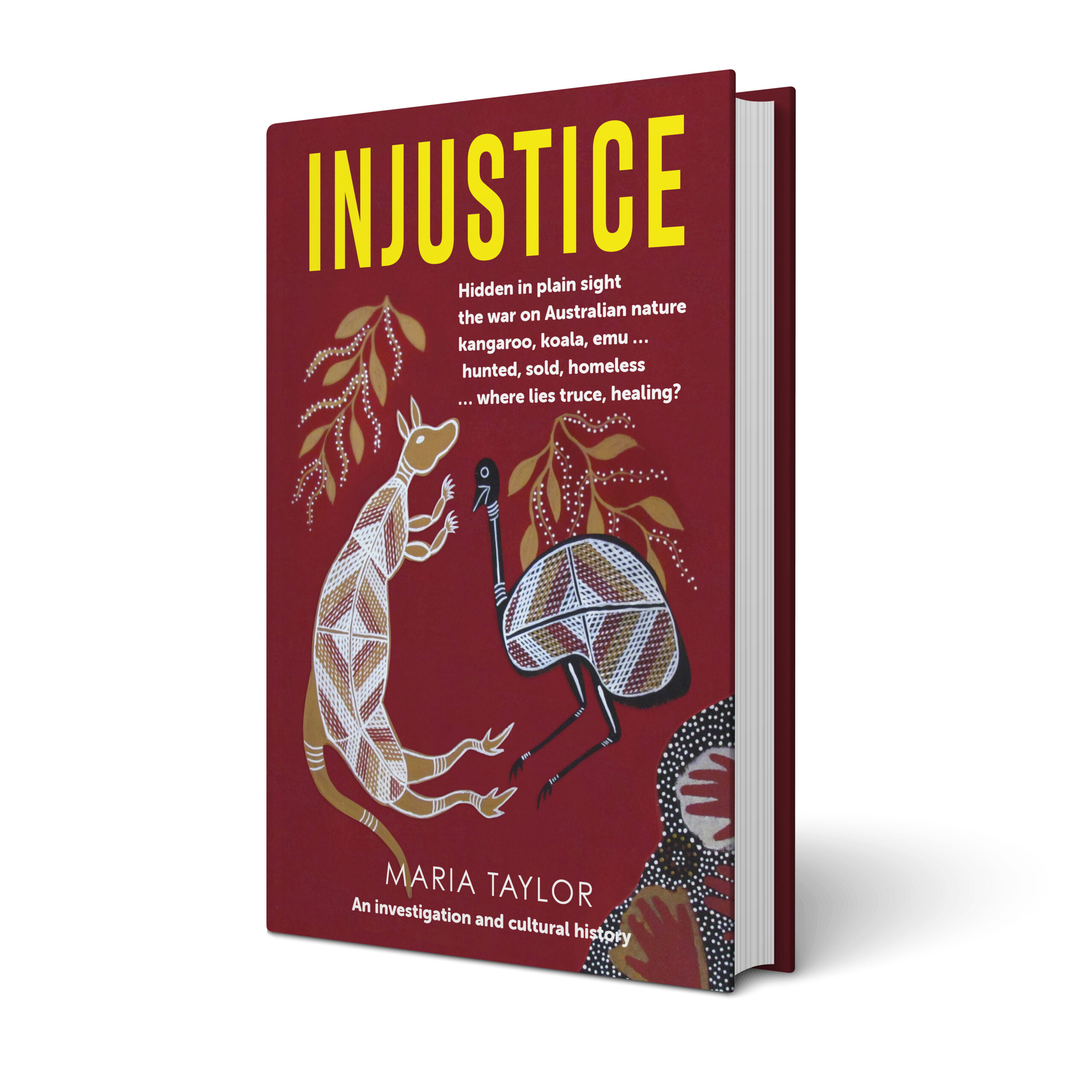
This hidden history and its blood -soaked contemporary legacy forms the subject of my recent book ‘Injustice- hidden in plain sight the war on Australian nature’….  followed by some positive contemporary stories of rewarding co-existence with the nature of Australia. My research sought understanding of the extraordinary hold that political/economic narratives maintain over Australians – as demonstrated by the national silence in the face of brutal contemporary management of some still ’common’ native species of mammals and birds.

Wildlife management still a killing culture

Dingos, emus, wombats, kangaroos and wallabies, possums, eagles, various seed-eating cockatoos and other bird species all face lethal ‘management’ by gun or poison from state governments and private landholders.  These animals have been demonised as ‘pests’ since settlement and are still removed, charged with ‘competing’ with domestic stock for grass or other vegetation like saltbush, or they are accused of damaging crops and fences or of being unacceptable predators. Ducks and other waterbirds annually face the guns of ‘recreational’ hunters in some states.
More than 60 species of macropod (that is the kangaroo species big and small, thus named because of unique big feet) inhabited Australia at the time of European settlement in 1788. Roughly one quarter of that pre-settlement number is now classified as nationally or regionally extinct or suffering greatly reduced numbers.
See Injustice p123

World’s biggest on-land wildlife slaughter. What do we know?

The fate today of the remaining large kangaroos– Red, Eastern and Western Greys, and Wallaroo or Euro – is to be victims of an industrial-scale wildlife trade largely hidden from the public. The ruthless practice of removing native grazers has morphed into a commercial trade with its own demands.
The Australian kangaroo, the icon that holds up one side of the national coat of arms and is freely used as a tourist attraction and name for sports teams, is also slaughtered en masse for its body parts in a wildlife trade that has grown since the 1950s. Together with non-commercial killing on farms and, strangely, in the national capital, Canberra,  kangaroo removal and the commercial trade now constitute the world’s largest on-land killing of a wildlife species.
With a green light from state governments and access to many private landholdings, an army of poorly-paid shooters invades the bush at night, often with children in tow (as publicly-posted evidence shows), to kill and field-butcher kangaroos destined for processors in cities.
kangaroos

The kangaroo trade is essentially a bushmeat, petfood and leather trade. Other than the domestic petfood business where whole kangaroo families go into the mincer, “jump steak” and leather (destined for sports shoes) are mostly exported to Europe and the US, not without controversy and [occasional] international wins against the industry.
Despite Australian processors and some academic backers urging citizens to eat kangaroo to maintain this industry and also to “save” the animals from the possibility of starving or being mistreated by graziers, Australians have largely avoided eating their national icon.
Federal and state government support (including overseas lobbying for the trade), frames the commercial kangaroo hunt as a ‘must have’ export industry and a boost for Australian farmers and “jobs”, that everyone would agree with. A narrative of endless abundance accompanies kangaroo “harvesting” as they call it. There have been few if any balancing voices heard in the public square.

Koala hunts set the pattern

Illusions of endless abundance also accompanied the slaughter of koalas for their fur: an export trade from the late 19th century that escalated in the 1920s. Koala populations have never recovered.
WWII hero and foundation professor of zoology at Monash University Alan ‘Jock’ Marshall exposed the koala industry – particularly the notorious 1927 Queensland open season and the recorded political and citizen statements that surrounded it – in his 1966 anthology book The Great Extermination.
He wrote: “The organised savagery with which kangaroos are being hunted today’, is equalled in our history only by the appalling massacre of koalas in 1927.”
see Injustice p140
Political justifications from that time about impossible rapid breeding and recovery of koalas, as an export commodity vital to the state interest, foreshadow similar narratives justifying the kangaroo slaughter and trade today.
The Great Extermination is a dark chronicle, penned by Marshall and other scientists, recording the mistreatment, hunting and sometime extermination of Australian marsupials and other land-based wildlife starting with settlement, and the even earlier hunt of marine mammals. The extermination was not only direct or due to ignorance but was aided by the zoo of introduced species the colonists brought with them. Other chapters recorded the destruction of forests and woodlands for immigrant commercial agricultural projects.
When the book was published in the 1960s post -war ‘progress’ was pushing more housing, roads and business development across the land, further pressuring ecosystems. Marshall’s unvarnished and quaint subtitle reads: A Guide to Anglo-Australian Cupidity, Wickedness and Waste.
The chapter on birds reports the tragedy that befell that great mimic the bush lyrebird and other species, slaughtered for a few feathers to adorn Victorian hats. We also learn of the extensive killing, including bounties and egg destruction, that faced Australia’s other coat-of-arms upholder, the emu. Emu persecution on behalf of cropping enterprises continued in western Australia into the 1960s.
In 1932 emu destruction even evolved into a proper war complete with Commonwealth-issued machine guns. The emus fought them to a draw on that occasion with guerrilla scatter tactic.  National emu populations fluctuate around 700,000 birds that are now seldom seen in the south of the country. The unique flightless bird had in the early days delighted onlookers by fearlessly marched along Sydney streets with the new settlers.

Why does Canberra city kill kangaroos?

This is a good question. The ACT government organises an annual slaughter of kangaroos on nature reserves behind suburbs of the national capital that also calls itself the Bush Capital. Some 1600 innocent lives were dispatched in the winter of 2022 ( more annually since), 2022 the 13th year of a non-transparent program that also causes considerable trauma to residents who have loved their neighbourhood wildlife.
As a regional journalist, I reported on Canberra’s ‘cull’ for years and still have not pinned down why they do it and ignore condemnation – not least from overseas would-be tourists. A revolving series of justifications are offered to the public ranging from the ‘saving from starvation’ trope to the current so-called ‘conservation cull’ on behalf of other species. The trouble with that explanation is the lack of evidence showing conservation benefits.
There is also the little-known fact that nominating the cull for conservation purposes sidesteps advice in the code of practice to avoid killing females many of whom carry joeys. In the ACT, it seems, every kangaroo can be killed.
Guesses as to why this may be so range from pressure coming from the car insurance industry and suburban developers, to bureaucrats hanging on to the roughly million-dollar annual budget for kangaroo management, to the possibility of traditional mindsets inhabiting city politicians (Labor, Greens and Liberals) and their applied ecology advisers favouring removal and minimal native grazers. Kangaroo numbers are estimated and put into a shooting quota in a desktop exercise. There is no baseline study of these sentient family groups or their role in grassland environments. Canberra’s government has followed kangaroo removal with placing cattle and sheep on some of the reserves and badged that as ‘conservation grazing’.
In 2019 the ACT congratulated itself as the first Australian jurisdiction to officially recognise sentience, conscious feelings in animals, formally recognised in 32 countries by then. However, that was soon followed by the ACT reclassifying kangaroos from “protected” to “controlled” species. This not only took away legal avenues of dissent but presumably decided “controlled” mammals do not enjoy sentience?
The ongoing non-commercial killing of kangaroos in Canberra is part of the nation’s world-beating slaughter of this social herd animal and internationally beloved ‘Skippy’.  It looks like this:
“With no end in sight, cloaked with science but dog-whistling ‘pest’ the Bush Capital politicians, park bureaucrats and allied scientists have destroyed the structure of local kangaroo mobs. They’ve hired gunmen who are obliged to shoot adults and decapitate or bash small joeys, and bury them all in pits while leaving at-foot joeys to starve or jump in front of cars. They have traumatised residents and gone to great lengths to silence some of those with a more sympathetic and informed view of the kangaroo’s place in the environment.
“In just a decade, the national emblem in the national capital has been ever more bloodstained and diminished, rather than being celebrated as a vital player in biodiversity and as the international icon of Australia that kangaroos are.”
See Injustice p265
Australia’s kangaroo kill now dwarfs remaining whaling, Canada’s slaughter of fur seals or Japan’s of dolphins at Taiji, all of which Australian governments and citizens have loudly condemned. Do Australians know this is going on?  Do they wonder about the persecution of still common species in the rollcall of disappearing biodiversity? Do they consider the ethics of lethal management on behalf of profit or tradition, eschewing respect for these unique Australians or ecological understanding? Can we consider turning to peacefully sharing the land to mutual benefit as the First Australians understood?

About the author

Maria Taylor (PhD), is a journalist, author and former documentary filmmaker who is now a member of the AWPC managing committee dedicated to wildlife advocacy and habitat sustainability.  Her recent book:  Injustice: hidden in plain sight, the war on Australian nature….where lies truce, healing? expands the themes of this article with the history and facts of Australia’s lethal and unethical management of our native wildlife, a case study of the kangaroo hunt, and points to a co-existence future option.  More information at author website www.mariataylor.com.au   AWPC members are encouraged to use and promote the book for ecosystem/wildlife and environmental education in Australia.